North London Chinese Association 北倫敦華人協會
06/8/26 Home Office Seminar:-
Home Office’s Answers to questions raised by attendees, that have been grouped into themes.
Q&A
No Time Limit (NTL) and legacy documents
No. Their immigration status remains valid and they can continue to use permitted legacy evidence of their status. However, we strongly encourage them to obtain an eVisa through a free No Time Limit (NTL) application so they can benefit from easier status sharing and smoother travel.
Yes. People who hold ILR or ILE in a passport vignette, wet-ink stamp or other legacy document can make a free NTL application to obtain an eVisa.
Processing times can vary depending on the complexity of the case and whether further checks are needed. Customers should refer to GOV.UK for the latest information. We cannot guarantee a specific timescale.
The process has been simplified and digitised, but processing times still depend on individual circumstances and the evidence available. Customers should check GOV.UK for the latest service information.
Yes. Current guidance allows applicants to leave the Common Travel Area while their NTL application is being considered. However, customers should ensure they have evidence of their status and appropriate travel documentation before travelling.
Applicants should follow the instructions provided in their acknowledgement correspondence and use the appropriate UKVI contact channels where necessary.
It means UKVI may contact an applicant if additional information, documents or clarification are required before a decision can be made on the application.
This could include identity documents, passports, evidence supporting settlement status, proof of name changes, or other documentation needed to verify the applicant’s record.
UKVI will contact the applicant directly using the contact details provided in the application. Applicants should check their email, including junk or spam folders.
International travel and airline recognition
Yes. Valid legacy evidence can continue to be used for travel while customers transition to an eVisa. However, obtaining an eVisa may provide a smoother travel experience.
Carriers are responsible for checking travel permission. Customers relying on legacy documents should ensure they travel with the relevant evidence. Failure to carry appropriate documentation may result in additional checks or travel disruption.
Customers should explain the type of status they hold and present their evidence. Where available, an eVisa linked to a UKVI account can assist carriers in verifying permission to travel through Home Office systems.
The Home Office continues to engage with carriers and provides systems that enable permission-to-travel checks. eVisas further support automated verification processes.
Airlines rely primarily on Home Office travel-permission checking systems rather than individual letters. eVisas support automated verification directly against Home Office records.
Carriers use established Home Office carrier support and permission-to-travel checking arrangements. These checks increasingly rely on automated systems linked to immigration records.
While not mandatory, customers may wish to contact their airline if they are concerned about their documentation. Travelling with all relevant evidence remains important.
Customers should explain that an eVisa is separate from a passport. Where necessary, they can access their immigration status through their UKVI account and may pursue an NTL application if they still rely on legacy evidence.
Chinese/Asian names and UKVI records
UKVI records names based on information provided in official identity documents. Different international naming conventions are recognised, but records must accurately match the identity evidence supplied.
2-3. What if the order of names differs between a passport and UKVI record? Which format should be used?
The details held by UKVI should match the customer’s passport and travel document. If there is a discrepancy, customers should request a correction before travelling or sharing status.
UKVI must ensure that immigration records remain secure and accurately linked to the correct individual. Evidence such as passports may be required to verify the correction.
UKVI continually reviews customer feedback and seeks to improve services for all users.
Potentially yes. Differences between the passport and UKVI record could affect identity verification and travel checks. Customers should correct errors before travelling.
UKVI continues to improve digital services and correction processes, but identity verification remains important to protect customers and maintain the integrity of immigration records.
eVisas, passports and UKVI accounts
No. The immigration status remains the same and a new eVisa application is not required solely because a passport has been renewed.
Yes. Customers should update their UKVI account with their new passport details. Their immigration status remains securely recorded even when passport details change.
A UKVI account is an online account that allows customers to view their immigration status, update personal details and generate share codes where applicable.
Yes. Detailed guidance and customer support materials are available on GOV.UK.
Not always. The route depends on the customer’s circumstances. Many services can be accessed through GOV.UK and a UKVI account.
Customers can sign in to their UKVI account using their existing credentials and update account details where required through the online service.
Customers should follow the account recovery and sign-in guidance available through GOV.UK and UKVI support channels
Customers experiencing technical or account-access issues should use the relevant support and error-reporting services available on GOV.UK.
Right of Abode and digital Certificates of Entitlement
1-2. Will Right of Abode holders automatically receive a digital Certificate of Entitlement? Do physical holders need to convert?
The Certificate of Entitlement is moving to a digital format. Whether an individual needs to take action depends on their circumstances and existing documentation. Customers should follow the guidance provided by UKVI.
UKVI has published guidance on the transition and will provide information to affected customers where appropriate.
Customers should follow the guidance relevant to their circumstances. Access to a digital Certificate of Entitlement will require a UKVI account.
Customers should ensure they have valid evidence of their Right of Abode and that their travel document is linked to their UKVI account before travelling.
Current arrangements depend on the circumstances and validity of the document. Customers should follow the latest UKVI guidance regarding digital transition.
Customers should keep their UKVI account updated with their current passport details. The key requirement is ensuring the correct travel document is linked to the account.
Security of existing immigration status
No. An eVisa changes how immigration status is evidenced, not the underlying immigration status itself.
No. Moving from physical evidence to digital evidence does not remove or reduce a person’s existing status or rights.
The answer depends on the individual’s immigration history and current status. Customers concerned about their specific circumstances should seek advice from UKVI or an accredited immigration adviser. General changes to status do not occur simply because evidence becomes digital.
Voluntary return / reintegration
These schemes are generally designed for people who wish to leave the UK voluntarily and who do not have a permanent right to remain.
Generally no. People with ILR, ILE or Right of Abode already have permission to live in the UK permanently and would not normally need to consider voluntary return arrangements.
The latest heat wave is the fifth to batter European countries since May as scientists warn that the continent is warming faster than any other. Here’s what to know. https://trib.al/nPkE0sQ
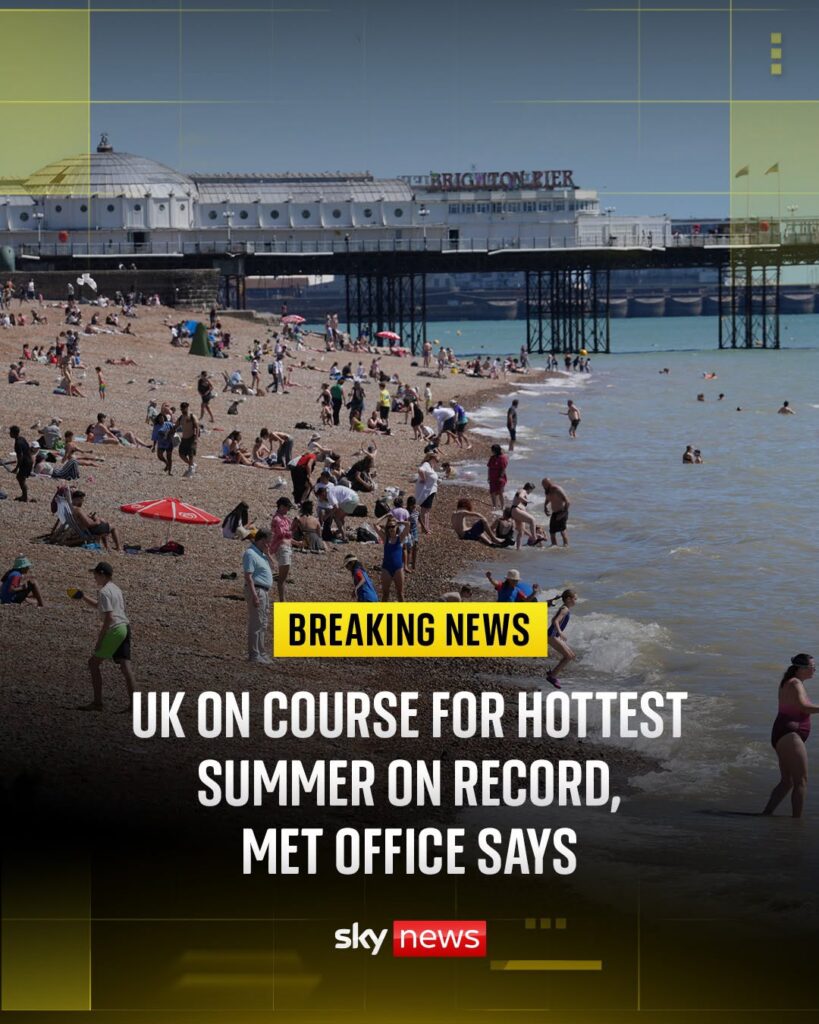
From SkyNews: https://news.sky.com/story/uk-heatwave-latest-weather-live-wildfire-summer-13571553?postid=12209036#liveblog-body?
Temperatures will climb north of 30C today and could hit 38C in some places on Thursday. Thousands of homes are without water amid widespread drought conditions, and firefighters are still battling a blaze in the New Forest. It’s led to the PM calling a COBRA meeting. Follow the latest.
The UK is on course for its hottest summer on record, the Met Office has said.
As things stand, the UK is well above its mean average temperature for summer so far (1 June to 10 August).
Currently it stands at 16.48C, which is 1.88C above the 1991-2020 average.
To become the confirmed hottest summer on record, the remainder of August can actually experience weather below the 1991-2020 average.
England has experienced even hotter temperatures than the rest of the UK, with a mean summer temperature 2.46C above the previous record.
If it comes to pass, this summer would surpass the record set only last year. Met Office senior scientist Mike Kendon said:
“Another record-breaking summer now looks increasingly likely for the UK, following the second-warmest June, and second-warmest July on record and yet another heatwave imminent.”
Pointing to repeated occasions in which the UK experienced temperatures of 35C or more, Kendon added:
“These statistics are a clear reminder – if one were needed – of the stark changes that we are seeing in the UK’s climate.”
Advancing Responsible and Sustainable Business Leadership

WORLD BUSINESS FORUM & AWARDS
22 September 2026 • 11.00 am – 2.30 pm • The East India Club (16 St. James’s Square, London)
About This Event
The World Business Forum & Awards marks the official launch of the World Business Chamber (WBC), an independent, non-aligned platform for ethical, responsible and sustainable business leadership. Operating across the major trade blocs of Asia Pacific, Europe and the Middle East, WBC is designed to be a trusted bridge between government, business and civil society at a time when geopolitical tensions and shifting trade patterns are making cross-border investment increasingly complex.
This half-day Forum brings together senior business leaders, policymakers and institutional partners for substantive dialogue on the challenges reshaping global trade and investment. The programme culminates in the presentation of the inaugural World Business Awards, recognising organisations and individuals advancing responsible and sustainable business practice, as WBC is formally inaugurated as a new voice for responsible growth.
Programme
11.00 am – 11.50 pm
Registration and Networking
11.50 am – 12.00 pm
WELCOME SPEECH
Tun Dato’ Seri Zaki Tun Azmi
Patron, World Business Chamber (WBC); Former Chief Justice, Malaysia and; Former Chief Justice, Dubai International Financial Centre (DIFC) Courts
12.00 pm – 12.45 pm
SPECIAL PANEL DISCUSSION
Navigating Geopolitical Risks and Geoeconomic Challenges: Building Resilience and Strengthening Sustainability
Proposed Speakers:
The Rt Hon. Lord Jonathan Marland
Chairman, Global Board of Advisers, World Business Chamber; Chairman, Commonwealth Enterprise and Investment Council; Former Trade Envoy of the British Prime Minister and; Former Minister of Energy and Climate Change, UK
Baroness Manzila Pola Uddin
Member of the House of Lords UK
Tan Sri Dr Munir Majid
Chairman, International Executive Council, World Business Chamber (WBC); President, ASEAN Business Club; Founding Chairman, Securities Commission Malaysia and; Former Chairman, ASEAN Business Advisory Council Malaysia
H.E. Kim Heung-chong
Ambassador of the Republic of Korea to the United Kingdom of Great Britain and Northern Ireland
Mr Andrew Khoo
Co-Chairman, World Business Chamber (WBC) & Chairman and Chief Executive Officer, The MUI Group
Ms Lai Mei Sim, OBE DL
His Majesty’s The King’s Representative for London Borough of Brent (2007-2026) & Chairman, British Malaysia Society (2018-2026)
Moderator: Sir Iqbal Sacranie
Vice-President, World Business Chamber (WBC) & Chairman, Muslim Trade Forum (MTF)
12.45 pm – 1.00 pm
KEYNOTE ADDRESS
Proposed Speaker: Lord Sadiq Khan, Mayor of London (TBC)
1.00 pm – 1.05 pm
Toast to the King
1.05 pm – 2.00 pm
Lunch
2.00 pm – 2.25 pm
PRESENTATION OF WORLD BUSINESS AWARDS
Proposed Keynote Speaker
H.E. Dato’ Indera Dr. Azfar bin Mohamad Mustafar
High Commissioner of Malaysia to the United Kingdom
Guest-of-Honour
The Rt. Hon. Boris Johnson
Former Prime Minister of United Kingdom and Former Mayor of London
Group Photography
2.25 pm – 2.30 pm
Vote of Thanks
2.30 pm Carriages
Contact
Mr Zaim Mohzani (zaim@kasi.asia) or Ms Caroline Cheong (caroline@kasi.asia)
Secretariat of the World Business Chamber (℅ KSI Strategic Institute for Asia Pacific, A-08-01, Plaza Mont Kiara, No. 2, Jalan Kiara, Mont Kiara, 50480 Kuala Lumpur, Malaysia)
The programme is tentative as of 5 August 2026.
Mayor of London has an open consultation on libraries. In an increasingly disconnected world, our libraries are a source of connection in local communities, where diverse books are shared, author visits and language rhyme times for children take place, where immigrant families can seek helpful information and many libraries have been third party reporting centres.
Please do consider contributing your thoughts to the consultation and keep these essential services publically open and available to communities.